- Discussions/
- #467/
Polkadot Mexico: Phase 1 University Pilot
Phase 1: University Pilot and Proof of Concept
Proposed by: Polkadot Mexico
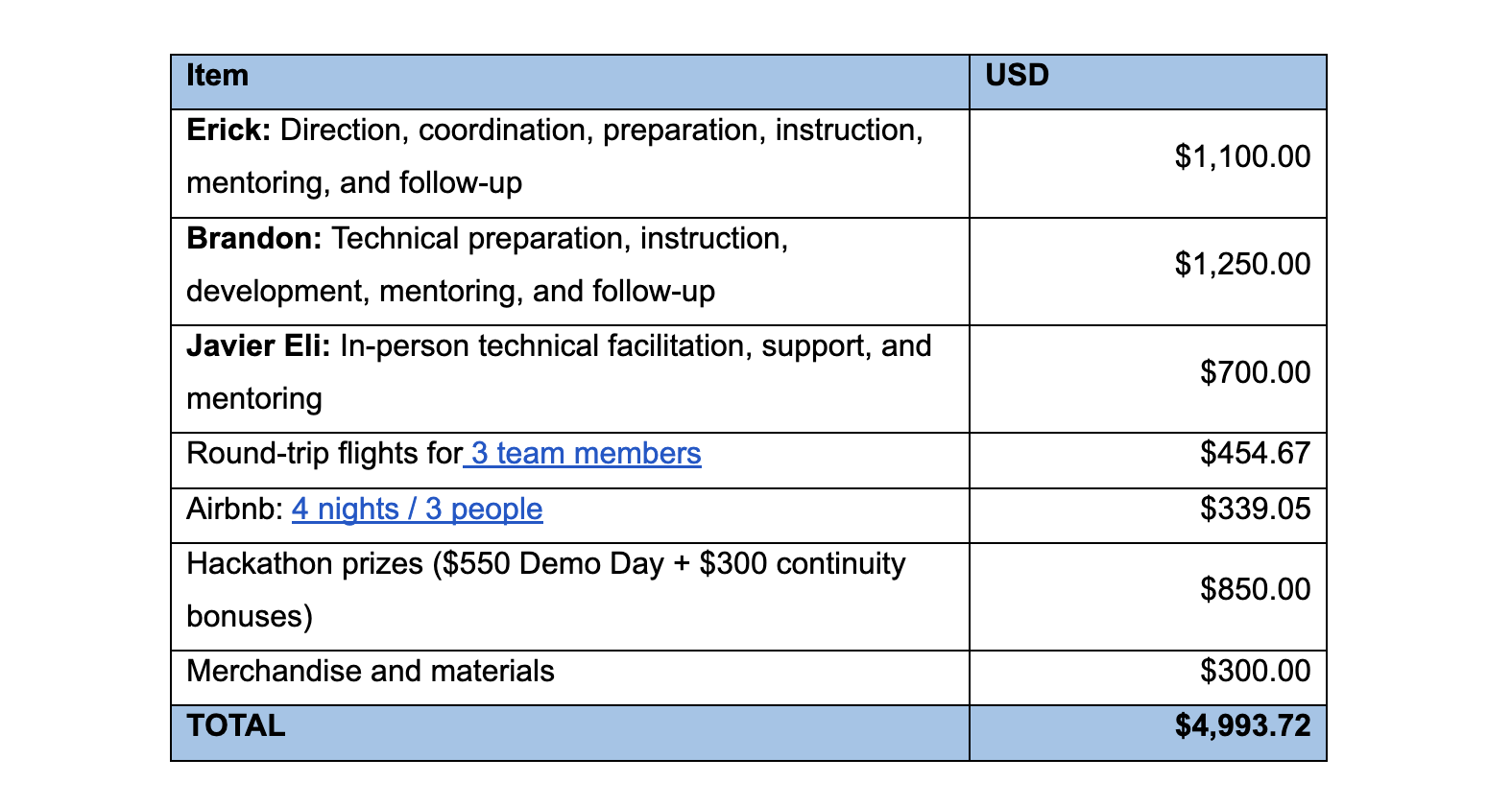
Requested Allocation: $4,993.72 USD
Beneficiary: 16erHfjin7aWozKBpEU6ocxtJY7t38pFnnHvhHLiJYSywS3t
Duration: 4 weeks (in-person event October 29, 30 and 31, 2026)
Venue: Universidad Autónoma de Nuevo León (UANL), Monterrey, Nuevo León
Description: Polkadot México is proposing a 4-week university pilot at UANL to validate the complete Polkadot University Mexico model: education, practical use of the Polkadot App, building, a compact hackathon, mentorship, and follow-up. Instead of requesting funding for the full 5-month program, this proposal funds the smallest unit of the model that can be measured from start to finish.
This pilot measures distribution, not attendance. Every participant installs the Polkadot App and completes a verified on-chain check-in on day one, the hackathon produces mini apps people can actually open, and we measure who is still active at Week 2, 3 and Week 4. Every step is recorded on-chain through a participation tracking app built by our team.
Why a Pilot?
The question this pilot answers is simple: can we take a group of university students (users) from their first contact with Polkadot to shipping products, and keep them active after the event?
If the answer is yes, we will have real evidence to justify a larger program. If not, the ecosystem learns what needs to change before investing more.
Program Structure
Preparation: coordination with UANL, campus and social media promotion, and development of the participation tracking app.
Bootcamp: 2 days at UANL facilities.
Expected reach: 25 students.
Hands-on: Polkadot App install, QR-based on-chain check-in, tool setup, and guided exercises.Target: 20+ verified check-ins.
Building: team-based work with technical support. Expected: 4 to 6 teams.
Hackathon: 8-hour compact hackathon + Demo Day. Expected: 4 to 6 published, openable mini apps.
Follow-up: Week 2-3 and Week 4 checkpoints measured through the tracking app.
Learning model: Learn → Install → Use → Build → Ship → Continue
Event Schedule
Thursday 29: Bootcamp. Polkadot App install, on-chain check-in, tools, and first exercises.
Friday 30: Building, team formation, and hackathon preparation.
Saturday 31: Hackathon, mentoring, Demo Day, and awards.
Curriculum
Module 1, Understanding Polkadot: Web2 problems and digital sovereignty, blockchain fundamentals, Bitcoin to Ethereum to Polkadot, and first interaction with the Polkadot App and Products for People.
Module 2, Building on Polkadot: Development environment setup, smart contracts and PolkaVM, Solidity and/or Rust depending on the cohort's level, and a first functional app or prototype.
Module 3, From Learning to Building: Problem selection, team formation, MVP definition, development, and demo preparation.
The Participation Tracking App
Day 1 check-in: Each participant installs the Polkadot App, creates their account, and scans a QR code at the venue. That scan is their first verified on-chain interaction and the moment they become a Polkadot App user, not just an attendee.
Participation badge: After check-in, the app issues an NFT-style badge that updates as the student completes the bootcamp and the hackathon.
Event tracking: Bootcamp attendance, team formation, and hackathon participation recorded in one dataset.
Follow-up tracking: Active users and live projects measured after the event, and the continuity bonuses are settled against these records.
Note: The app is covered by the team fees, with no separate charge.
Hackathon and Prizes
Challenge: Build a product that solves a real, everyday problem for people using Polkadot. Teams should start from a need they see in their own lives, their families, or their communities, and build something a regular person could open on their phone and actually use.
Tracks: Identity & Proof of Personhood, University Credentials & Assets, Community & Governance, Gaming & Interactive Experiences, AI + Polkadot, and Open Track.
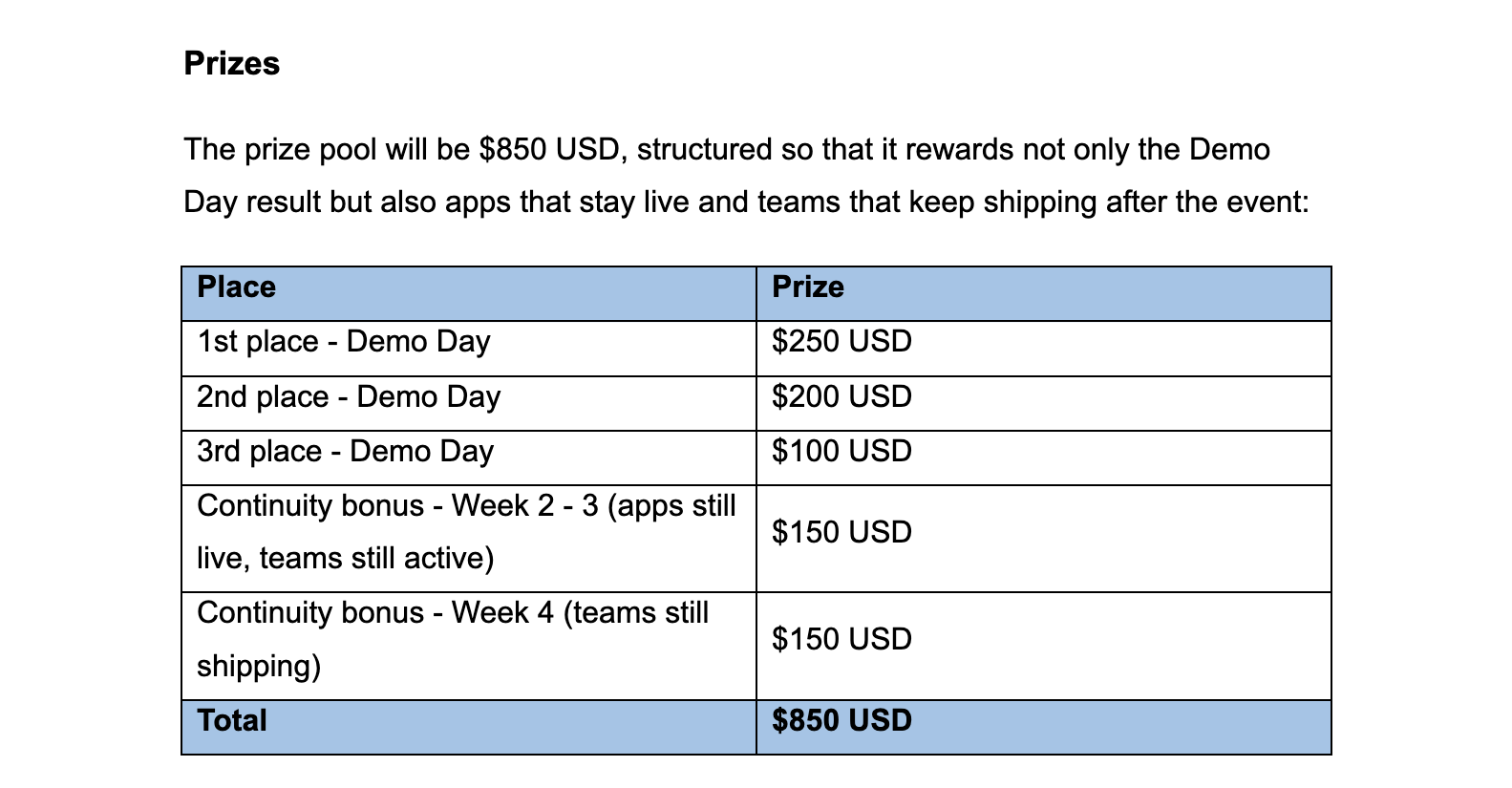
Participants who complete the bootcamp and hackathon receive official recognition from UANL, also issued on the Polkadot testnet as a badge held in their own Polkadot App.
Follow-up and Retention
- Week 2-3 checkpoint: Participants still using the Polkadot App and apps still live.
- Week 4 checkpoint: Teams still shipping and app users still active.
- Technical support between checkpoints to unblock projects.
- Identification of students who could become builders or community leaders.
Since some participants may not have a strong technical background, we leave open the possibility of requesting a small follow-up budget for post-event online sessions, only if the pilot shows it is needed.
Budget Breakdown
KPIs and On-Chain Verification
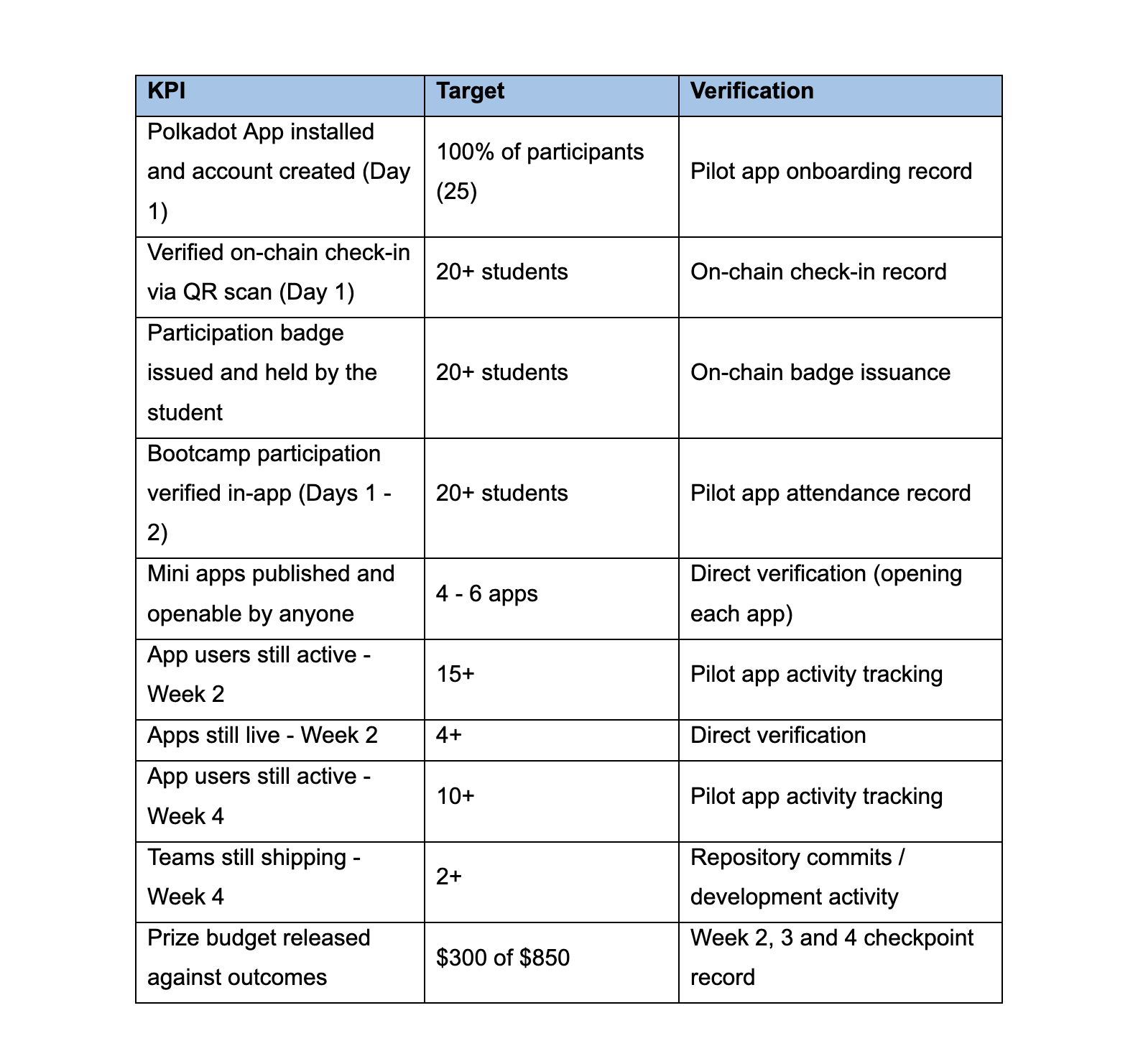
Execution model: Polkadot App installed → Verified on-chain check-in → Participation badge → Building in teams → Published, openable app → Still active at Week 2,3 → Still shipping at Week 4
Team
Erick Ramos: Project Director, Instructor, Mentor. Co-founder of Polkadot México (2022).
Brandon Correa: Technical Instructor, Lead Developer, Mentor. Polkadot Ambassador focused on Web3 development and PolkaVM. Founder Aradia
Javier Eli: Technical Facilitator, Instructor, Mentor. Community growth specialist with experience organizing university hackathons across LATAM.
Partner University
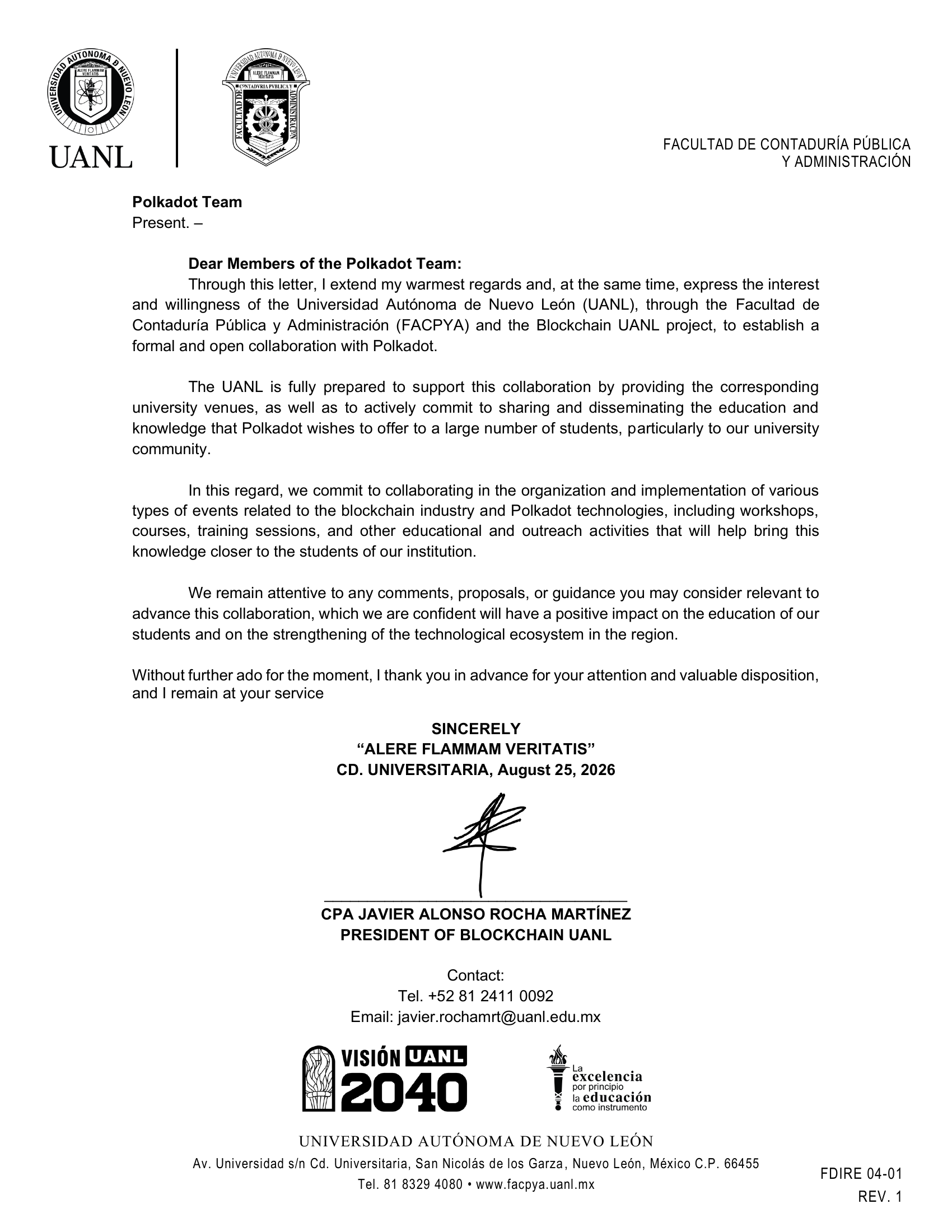
UANL issued an official letter of support through FACPYA and the Blockchain UANL project, who will provide venue access and support promotion across Systems Engineering and other computing programs on campus.
Transparency and Accountability
- Participant and activity records generated on-chain through the tracking app
- Public project repositories when applicable
- Receipts for every operational expense
- Final report comparing results against the KPIs, with a scaling recommendation
Phase 2
If the pilot shows healthy conversion across onboarding, building, and continuity, the next step is to replicate the model in 1 to 2 universities with larger cohorts and extended follow-up. Phase 2 is not automatic: it depends entirely on the evidence from this pilot.
Previous referenda for context: #1896, #1929
Polkadot México on X: @PolkadotMexico_
Full Proposal: [Google Doc link]
Full Proposal: IPFS
We're not asking the community to believe in a full program before seeing it work. We're proposing a concrete test: students who install the Polkadot App on day one, build on it by day three, and are still active weeks later, with every step recorded on-chain.
Reply
Up
Comments